
We’ve heard many welcome tributes to Dolly Parton and her great role as the Book Lady. As most know, one of Dolly Parton’s many contributions and her passion was Dolly Parton’s Imagination Library.
Former PBS NewsHour correspondent John Merrow recently shared an interview he had with Dolly where she explains why the Imagination Library matters. Her discussion is especially interesting for reading instruction, and he has given me permission to share his blog and discuss Dolly’s words further. I encourage you to visit his link and watch the videos.
Read to Baby!
Dolly Parton understood children and how they learn. She knew the critical importance of picture books, even at birth. That’s when the Imagination Library starts giving books to children.
Merrow asks Dolly why then. Why read to a baby? Most of us would wonder, but it’s becoming increasingly clear that reading to a baby is a critical step.
Dolly talks about giving children a good start, knowing they own their own book, and helping them understand how important they are. What she may or may not have known was that reading to babies matters!
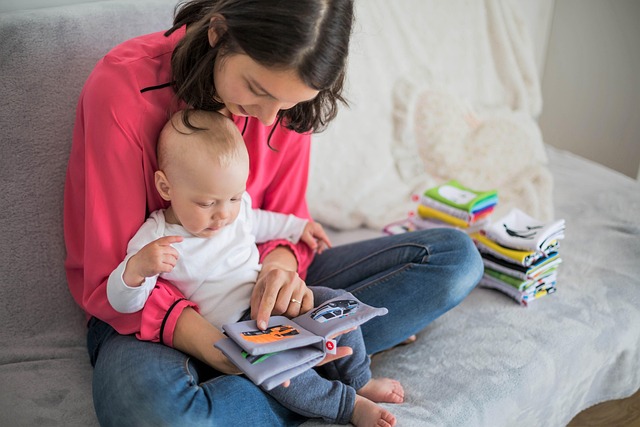
The American Academy of Pediatrics recommends reading at birth. Why?
The sound of a soothing voice, a baby cuddled in a caregiver’s arms, the words a baby hears, and, as they get a little older, the pictures (babies especially like baby faces) help children with language from the start.
Years ago, without knowing this, I found that voicing the words softly and pointing to pictures quieted my baby during a bout with colic. It helped get us through that difficult time. My husband and I never stopped reading and emphasizing books, and our child loved reading from the start.
Dolly Parton did a wise thing insisting that every child get a book at birth! I tell any new mom, or future mom, to have plenty of picture books ready for when they begin a new life with baby. Read, read, read from the start! See Babies Need Books.
And every child needs books of their own to cherish. Dolly gets children off to that great start at birth. Parents should not wait to read that book. Read it to baby!
Check out this CNN video.
Dolly Could Not Remember Learning to Read!
Dolly Parton loved to read, but she revealed in the Merrow interview, she came from a home where there were no books other than the Bible. Her parents could not afford to pay for books if they were lost or damaged, and with so many young children that was a likely possibility.
Dolly did not get the books that seem crucial for children to read well. So how did she learn to read so effortlessly, and how is it that she can’t remember when or how she learned to read, only that she absolutely loved to read? I found this fascinating.
What Dolly did recall were the Bible readings and the stories her mother told. At one point she tells how she loved the stories she heard about the Old Testament and she found them visual. It sounds like much vivid auditory language existed in the Parton household.
Today, reading instruction is overly focused on skill acquisition, words children see and hear, but which might not be enjoyed. Less attention is paid to the rich language children hear in their lives and also speak.
Consider how young children talk a lot, relying on auditory language as much as the visual component. They’re listening to their words, reinforcing sounds and words they find interesting. This is especially critical for children born with health difficulties, or considered to have disabilities. Positive feedback from adults closest to them matters.
Dolly also liked writing. Writing and reading go hand and hand.
I don’t know why Dolly couldn’t remember how she learned to read, especially without exposure to books, but I would guess that despite a poor household, she had grown up in a rich language environment.
The words and sounds she heard were enticing and later when she was in school and the teacher taught reading, her rich vocabulary and the sounds she knew were given flight. She had been exposed to much information which probably helped make reading come easily.
In addition, Dolly talks about her dad’s illiteracy but that he was very smart. Dolly, as we know, was very smart as well which likely allowed her to pick up sounds and reading effortlessly, and also helped her become a great lyric writer.
Honor Dolly with the Imagination Library and Great School Libraries!
It should not go unnoticed, that it took the Book Lady’s attention to help young children get picture books that matter. While I’m grateful to Dolly, and I hope the Dolly Parton Imagination Library will keep up the wonderful work in their founder’s name, it also raises a question as to why it took a celebrity to remind the rest of the country, the importance of reading books to children.
Some still don’t get it. Maine, Missouri, Washington reduced or cut funding or support to Dolly’s program. Indiana and Washington might be working to find other funds. If they have financial woes, why can’t one of the billionaires step up? Why isn’t this seen as critical to the education of America’s kids?
Consider that states like Missouri have also underfunded their school libraries and have reduced the credentials and qualifications of school librarians.
Why, with a rich nation like ours, can we not afford to provide children with books they love and which will help them to learn to read? I think you likely know like I do that the country has mixed priorities!
While money is poured into unproven AI and state mandates that push online reading for a so-called Science of Reading, what we know works, getting books children like so that they will read, is seen as just an extra perk.
How many poor schools have lost school libraries and school librarians? How can we expect students to grow up liking reading, understanding its importance? Research is clear that schools with well-resourced school libraries and librarians also have higher reading scores.
It took the Book Lady from the Tennessee Mountains, a woman who knew struggle, but also understood gratitude, deep abiding gratitude for how she became recognized and popular in America, and who wanted so much to give back, to showcase the importance of books to learning.
She will always be remembered as that giver. Her legacy and love for all, including and especially for the children, will live forever. And I hope her legacy will help Americans see what is truly important in teaching children to read—the great joy of owning a book that is all theirs and being read to by the loving adults in their lives.
Very thoughtful and comprehensive…and well-written to boot
Thanks, John! It was a fascinating interview and felt very authentic. I appreciate your letting me share.
AMEN! In the depths of the teen pregnancy crisis I had an eighth grader come up to me and tell me she was expecting. She saw this as good news. I looked at her and told her that once that baby was born the most important thing she should do is read to him or her. She looked at me as if baffled by the idea. I often reflect on my own reading journey, the latency and disinterest early then the sudden drive to comprehend. I have read “Sapiens” by Yuval Harrari, who contends that the survival of homo sapiens has been dependent on stories as connectors, not simply words or codes. Dolly Parton represents a special perspective that we treat as if it is a secret code. It was love by doing and being. That’s why and how we read.
Thank you, Paul. Absolutely!
One line here saddens me: the swipe at the “so-called Science of Reading.”
Look at the childhood Bailey herself describes: stories, rich oral language, sounds, vocabulary—and then a teacher teaching Dolly to read. There is no three-cueing here. No running records. Nothing in Parton’s story argues against systematic phonics.
So why the swipe?
I increasingly think this kind of language serves to police the boundaries of the conversation: support systematic phonics or the Science of Reading and expect a little sneer in passing.
That’s unfortunate. We should be able to argue about evidence without signaling which people and ideas respectable readers are supposed to disdain.
States are spending millions on unproven, Science of Reading-mandated programs, mostly online. And children are pushed to learn sounds earlier than ever.
Meanwhile, school libraries have been closing. I rarely hear those who cite evidence with the SoR mention the evidence behind school libraries.
I don’t know if Dolly Parton cared about phonics. But I know she cared about books, and many children will become good readers because of her caring.
https://news.jrn.msu.edu/2026/03/as-more-k-12-schools-drop-libraries-worry-grows-about-impact/
Nancy, I agree with you about school libraries. Closing them is a bad thing. I also share your concern about excessive online learning.
But I don’t see the connection to the Science of Reading. Libraries were disappearing long before its recent momentum. It would make as much sense for me to connect three-cueing with nutritionally unsound school lunches. I might oppose both. That doesn’t make them connected.
The conflation with online learning is even harder to understand. Systematic phonics predates AI, the internet, computers—even electricity. Look at a hornbook: letters, sounds, syllables and words taught in deliberate sequence. You can hardly get more systematic than that.
A screen is a delivery mechanism. Phonics is an instructional method. They are not the same category of thing.
Some modern SoR programs use screens. Fine. Judge those programs—and their use of screens—on the evidence. But criticizing online learning tells us nothing about whether systematic phonics works.
Nor is the underlying approach “unproven.” The foundational evidence is hardly obscure. The National Reading Panel found systematic phonics significantly more effective than little or no phonics, and Ehri and colleagues’ meta-analysis of 38 experiments found significant benefits, particularly when instruction began early. Neuroscience converges with that behavioral evidence: research on literacy acquisition repeatedly implicates the networks connecting print and speech, and experimental work has identified a critical role for phonological decoding.
None of this says phonics is the whole of reading. It says that systematic instruction in the relationship between print and speech rests on a substantial peer-reviewed evidence base.
And yes, it makes a great deal of sense to scrutinize individual reading programs. We should ask how closely they align with sound, peer-reviewed, replicable evidence. We should examine their particular features and be skeptical of extravagant commercial claims.
But that’s not what you’re doing here. You’re taking questions about the efficacy of unspecified programs and using them to dismiss the underlying body of reading science as “so-called.”
The same thing happens with libraries and screens. You have good arguments against excessive online learning. You have good arguments for libraries and for getting more books into children’s hands. I agree with both.
But neither is an argument against systematic phonics.
And, respectfully, this becomes tiresome precisely because these are elementary distinctions. You know what conflation is. Whatever the intention, that is what the argument is doing here: library closures are conflated with SoR momentum; online learning with SoR instruction; questions about particular commercial curricula with the evidence for systematic phonics itself.
Those are separate questions.
Most importantly, none answers my original one: **what in Dolly Parton’s story argues against systematic phonics?** Your own account gives us stories, rich oral language, sounds and vocabulary—and then a teacher teaching Dolly to read.
This is why the little “so-called” saddens me. Foucault was perceptive about the management of discourse: one need not refute an idea if one can first mark it as an idea respectable people are expected to dismiss.
That’s an effective political tactic, in part because it is so efficient. A quick signal of disapproval can shape the boundaries of a conversation in two words. Answering it requires the tiresome work of separating claims, checking evidence and correcting conflations.
The sneer is cheap. The rebuttal is expensive.
Worst of all, none of it gets us any closer to the truth.
Books matter. Libraries matter. Rich language matters. Systematic decoding instruction matters. We don’t need to manufacture a conflict among them.
“While money is poured into unproven AI and state mandates that push online reading for a so-called Science of Reading, what we know works, getting books children like so that they will read, is seen as just an extra perk.”
The SoR is being used to sell unproven online programs. Point.
Phonics has been used for years, and the issue is using it more for children who need it. That argument is older than you likely remember.
If only those who claim a Science of Reading would also fight for school libraries. They always say they care, but do little.
Nancy, I think we agree on considerably more than we disagree about.
You write: “The SoR is being used to sell unproven online programs. Point.”
Fine. Point taken.
In fact, I think the principle behind your objection is stronger than you’re making it.
When public money pays for reading curricula, those curricula should demonstrate reasonable alignment with a robust evidence base, whatever label happens to be slapped on the box.
That’s not an impossible standard. Every workbook doesn’t need its own randomized controlled trial. But a public institution should be able to explain why what it’s buying is reasonably consistent with the accumulated evidence about how children learn to read.
You see what you did there? That’s where your argument takes us.
My response?
Please. Let’s go there.
California already has.
AB 1454, led by Speaker Robert Rivas and co-authored by Assemblymembers Al Muratsuchi and Blanca Rubio, requires instructional materials to align with evidence-based means of teaching literacy and California’s broader ELA/ELD framework. It absorbed Rubio’s earlier evidence-based literacy bill; Rubio is herself a former public-school teacher. The measure passed the Assembly unanimously with bipartisan support and was signed by Gov. Gavin Newsom.
Public money. Evidence. Standards. Accountability.
I’m fine going all the way.
Don’t give a curriculum a pass because somebody printed “Science of Reading” on the box. Don’t give it a pass because somebody printed “balanced literacy,” “whole language,” “structured literacy” or “child-centered” there either.
Forget the label. Show me the alignment with the evidence.
And if vendors are exploiting the Science of Reading label to sell weak products, the remedy isn’t less rigor about reading science. It’s more.
But rigor requires keeping categories straight.
A screen is a delivery mechanism. A commercial curriculum is a product. Systematic phonics is an instructional method. The Science of Reading is a body of research.
A bad online product sold under the SoR label is evidence against the product. It isn’t evidence against systematic phonics or the underlying research.
Indeed, your next sentence—that phonics “has been used for years”—helps make precisely that distinction.
Then you write that SoR advocates “always say they care” about libraries “but do little.”
Here I think you’ve changed the rules of the argument.
Why is library advocacy an entrance examination for a debate about reading science?
You’ve selected an issue outside an organization’s stated remit, decided how much commitment to that issue counts as sufficient, and then used its supposed failure to meet that standard to diminish its standing on a different question.
How much library advocacy is enough? A statement? A campaign? A budget proposal? Who decides?
That’s not evidence about reading. It’s a test of who is sufficiently legitimate to participate in the argument, based on an adjacent commitment whose relevance and threshold you’ve chosen yourself.
SoR advocates surely have all kinds of views about libraries, technology, politics and everything else. Some you’ll like; some you won’t; most are irrelevant.
An argument doesn’t become false because its advocate failed somebody else’s test of ideological completeness.
So let’s follow the principle behind your own objection all the way:
If an online program makes a claim, scrutinize the program.
If a curriculum makes a claim, scrutinize the curriculum.
If systematic phonics is wrong, show where the evidence for systematic phonics fails.
Let the claim under examination remain the claim under examination.
You don’t want weak products hiding behind the Science of Reading label. Neither do I.
You want publicly funded curricula accountable to evidence. So do I.
You want children to have books and libraries. So do I.
Splendid. What exactly are we fighting about?
Scrutinize the products. Ignore the labels. Teach the phonics. And evaluate the Science of Reading on the evidence for the Science of Reading.
What are we arguing about? One word. Alignment. Children develop and grow at different rates. Everyone who studies child development knows this. Children with disabilities often move slower but usually do get there. Alignment tries to measure everyone at the same rate/pace. It’s devastating to public schools where children grow and learn differently. And there’s the kindergarten push. Both those variables are why we are fed the lie that are kids are failing.
Invented spelling does not work with alignment. It lets students move at their pace. The way YOU would use it sounds like it would make it fit your SoR narrow alignment rules.
I see SoR as BS. We have always taught phonics, and all kinds of other skills, but SoR is direct instruction (which we’ve done too in the past). Some children usually with disabilities need more directed instruction. But most kids have learned to read well throughout the years.
That’s the difference.
Nancy, I agree with all of your research around sor. It is horrible and I am sick of people who arent teachers making these decisions. As always your piece is powerful and spot on.
Thanks, Stef. So glad about the work you do.